Running a shop
What thermal receipt paper actually costs a Hong Kong café
Nobody puts receipt paper in a budget. A roll costs about twelve dollars, it sits in a box under the counter, and when the box runs out someone orders another box. It is the definition of a rounding error.
It stops being a rounding error when you multiply it. Below is the arithmetic for a small Hong Kong shop — one counter, steady trade — using numbers you can check against your own invoices in about five minutes.
Start with the rolls
A busy single-counter café gets through roughly twelve rolls a week. At HK$12 a roll, that is HK$144 a week, and:
12 × 12 × 52 = HK$7,488 a year, in paper alone.
That is the number most people stop at, and it is already more than a month of most POS subscriptions. But it is the smaller half.
Then count the minutes
Paper does not only cost money, it costs counter time, and counter time is the expensive kind. Every week there is a jam, a reprint for a customer who wants a copy, a roll change during a queue, and somebody noticing the box is empty and putting in an order. Call it twenty minutes a week — which is conservative if you have ever actually timed it.
At HK$90 an hour for counter time, twenty minutes is HK$30 a week:
(20 ÷ 60) × 90 × 52 = HK$1,560 a year, in time.
The total
HK$7,488 in paper plus HK$1,560 in time is HK$9,048 a year, from one counter, before the printer itself is replaced and before a single customer asks you to email them a copy.
Your numbers, not ours. The four inputs above are defaults, not findings. If your rolls are HK$8, or you go through twenty a week, or your counter time is worth more than HK$90 an hour, the answer moves a long way. There is a calculator on the merchants page that recomputes as you type — put your real figures in and see what falls out.
The costs that never reach an invoice
Three more, harder to price and easy to feel:
- The receipt that faded. Thermal paper is not printed with ink; the paper itself darkens under heat. That reaction keeps going in a warm bag or a sunny window, and a slip filed in January can be blank by June. Customers do not blame the paper. They blame the shop.
- The reprint. Someone comes back for a copy for their company expenses, and now a staff member is digging through the roll history at the busiest hour of the day.
- The storage. Hong Kong retail space is the most expensive thing you rent, and a shoebox of curled thermal slips is sitting in some of it.
The part nobody mentions: what is in the paper
Thermal paper needs a colour developer to make the heat reaction work, and for decades that developer was bisphenol A. BPA is absorbed through skin, and monitoring studies have found higher BPA levels in the urine of cashiers who handle receipts all day than in the general population.
Regulators moved on it. The European Food Safety Authority cut its tolerable daily intake for BPA from 50 to 4 micrograms per kilogram of body weight in 2015, the European Chemicals Agency classified BPA as a substance of very high concern for reproductive toxicity, and Regulation (EU) 2016/2235 banned thermal paper containing BPA at 0.02% by weight or more from being placed on the EU market after 2 January 2020. Switzerland went further and banned BPS alongside it; a study of that ban found BPA-based thermal paper fell from 82% of the market to 11%.
Two things follow for a Hong Kong shop. First, those rules do not apply here — what is in the roll on your counter depends entirely on who made it. Second, the most common replacement developer is bisphenol S, and researchers have raised the same endocrine questions about BPS that were raised about BPA. “BPA-free” on a box does not mean bisphenol-free.
Worth one email. Ask your paper supplier which colour developer their rolls use. A supplier who can answer immediately is telling you something; a supplier who cannot is also telling you something.
What changes when the receipt is digital
The paper line goes to zero, which is the obvious part. The less obvious parts matter more:
- The reprint disappears, because the customer already has the receipt and can search it themselves.
- The receipt is still legible in year three, which is when a warranty claim actually happens.
- Nobody at your counter is handling coated paper forty times a shift.
- You get a record of the sale that is searchable by item and by customer, instead of a roll you throw away.
So what does Loop CheckOut actually do?
This is the part the arithmetic above is really about, so here it is concretely. Loop CheckOut is two apps either side of one sale: a point of sale that runs on an iPad at your counter, and a receipt app the customer already has open.
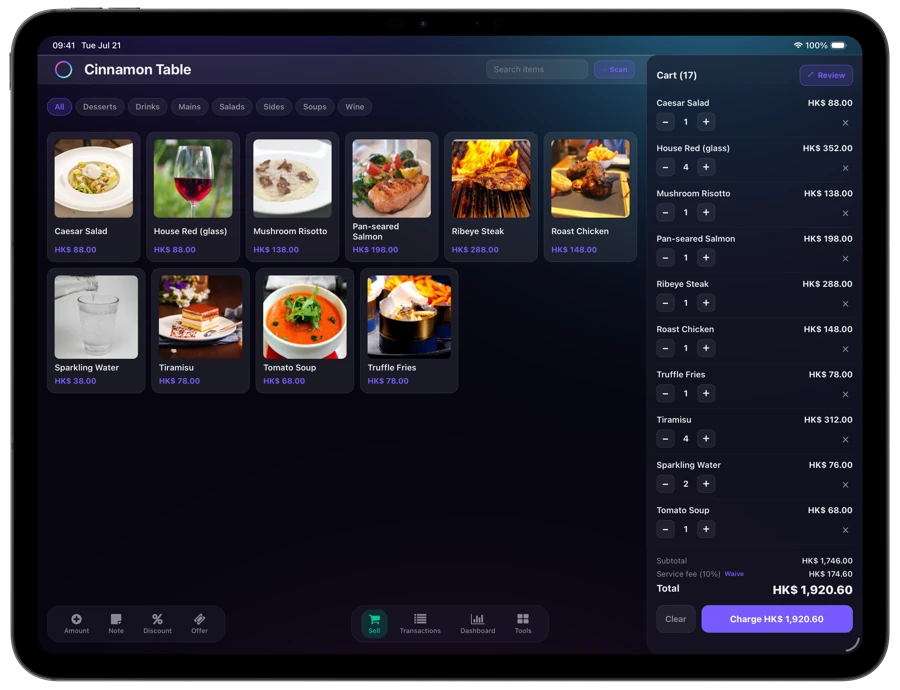
On your side that is a catalog with photos and categories, search, quantity steppers, per-line notes, custom-amount lines, a discount and a service charge you can waive per table, and a change calculator when they pay cash. Octopus, FPS, PayMe, AlipayHK, WeChat Pay and cards are all recorded as the payment method — Loop notes how a sale was paid, it does not process the money, so whatever you use today stays exactly where it is. If the connection drops mid-service you keep selling: sales are saved on the device and sync, receipts included, when you are back.
Then, instead of a slip, this is what the customer walks away with:
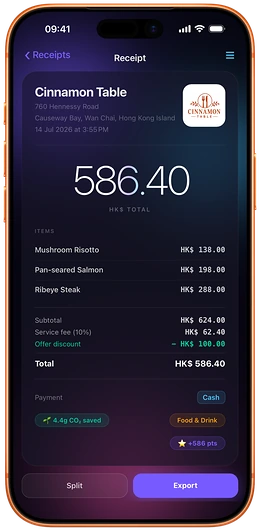
Every line item and price, the subtotal, the service fee, any discount, the payment method, the date, your shop's name and an order number. It is immutable: a sale can be voided, recorded against a reason and the person who did it, but nobody edits a receipt afterwards. Customers who do not have the app still get one — a guest receipt opens from a link or an on-screen code with nothing to install, and it is included on every plan including the free one.
From there it keeps working. A loyalty stamp fills itself off the same scan that delivered the receipt, so there is no second scan at the counter. Points, offers and campaigns sit on the paid plans. Your own side gets transactions searchable by item, amount, order number or customer, a Day Summary with the split by payment method for any date, and exports for your accountant.
The Starter plan covers the sell screen, the receipts, the catalog, guest receipts, offline mode and one loyalty stamp program, and it is free forever rather than a trial. Against HK$9,048 a year of paper, that is an unusually easy comparison to make. The POS guide has the full breakdown of what is in each plan, and what to ask any other vendor you are considering.
Start free, and see it at your own counter
Starter is free forever, not a trial. Tell us what you sell and what you run at the counter today, and we will get you set up.