Using your receipts
What a digital receipt actually saves, in grams
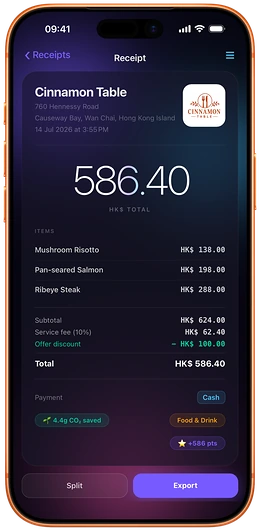
At the bottom of every Loop receipt there is a small green badge with a number of grams on it. On the receipt below it says 4.4 g CO₂ saved. It is a modest claim, deliberately, and it is worth explaining exactly what it counts — because a sustainability number nobody can check is not worth printing.
The whole calculation, in one line
This is the estimate the app runs on every receipt, and it is the same one behind the calculator on the merchants page:
area = (15 + items × 2) × 8 cm², then × 0.0065 g/cm² (thermal paper at 65 g/m²), then × 4 for lifecycle CO₂ per gram of paper.
Work the receipt above through it. Three line items, so the slip would have been (15 + 6) × 8 = 168 cm² of paper. At 65 g/m² that is 1.09 g of thermal paper. Multiply by the lifecycle factor of four and you get 4.4 g of CO₂. That is the badge. No black box, no offset market, no certificate: a strip of paper that was not printed, converted to grams with three assumptions you can disagree with.
Where it stops being trivial
Four grams is nothing. Four grams a few hundred times a day is not nothing, and that is the only reason the number is on the receipt at all — it is a per-transaction slice of an annual figure.
Run the merchants-page calculator with a busy single counter and you land around 65,520 receipts a year, which comes to roughly 78 kg of paper and 313 kg of CO₂, at an average of 4.8 g per receipt because a typical basket carries more lines than the three above. Those are the calculator's defaults rather than a measurement of your shop; put your own receipt count in and the figure moves accordingly.
What the number does not claim
Being specific about this matters more than the number itself:
- It is an estimate, not a certified figure. Three assumptions carry it — paper area per receipt, paper weight, and a lifecycle factor of four grams of CO₂ per gram of paper. Change any one and the answer changes.
- It is not an offset. Nothing is bought, retired or traded. It counts paper that was not printed, which is a different and much smaller claim than carbon neutrality.
- Digital is not zero. The receipt lives on servers and arrives on a phone that was manufactured and is being charged. The comparison is honest at the level of the paper, not the whole system.
- It says nothing about the rest of the meal. The food on the receipt outweighs the receipt by orders of magnitude. This is about the slip, and only the slip.
The part that is not measured in grams
The chemistry is arguably the better argument. Thermal paper carries no ink — it is coated so it darkens under heat — and the developer that makes that work was bisphenol A for decades, with bisphenol S the most common replacement. The EU restricted BPA in thermal paper from January 2020; those rules do not apply in Hong Kong, so what is in the roll on a given counter depends on who made it. That is covered properly in what thermal paper actually costs a Hong Kong café, alongside the money.
A receipt that never gets printed avoids the paper, the coating, the fading, and the box under the counter it would have ended up in. The 4.4 g is just the part that fits on a badge.
For merchants, the same estimate runs across every receipt issued and shows up as an annual figure. What the point of sale does around it is in the POS guide.
Start free, and see it at your own counter
Starter is free forever, not a trial. Tell us what you sell and what you run at the counter today, and we will get you set up.