Running a shop
How long a Hong Kong business has to keep its receipts
The number is seven years. Hong Kong businesses are required to keep sufficient business records to determine their assessable profits, and to keep them for seven years, under section 51C of the Inland Revenue Ordinance (Cap. 112).
Most shop owners know the number. What tends to go unexamined is whether the records they are keeping will survive the seven years — because for a great many Hong Kong counters, the records are a box of thermal paper.
What counts as a record
Broadly, the material that lets someone reconstruct what the business earned and spent: books of account of receipts and payments, records of income and expenditure, the underlying vouchers and invoices, and enough detail behind each entry to show what a transaction actually was. A total with no breakdown behind it is a weaker record than an itemised one.
That is the standard your sales records have to meet for seven years — not the day of the sale, not the end of the tax year.
General information, not tax advice. Exactly what your business must retain, and in what form, depends on how it is set up and what it does. Confirm the specifics with your accountant or with the Inland Revenue Department before you change anything.
Why thermal paper fails this test specifically
Thermal paper carries no ink. The paper is coated so it darkens where a heated head touches it, and the chemistry that produces the image does not stop once the receipt leaves the printer. Heat, sunlight, humidity and contact with plastics all keep it going, until the slip is uniformly grey and the transaction on it is gone.
Hong Kong is a warm, humid city, and a box under a counter is a warm, humid place. Slips filed at the start of a year are routinely unreadable by the end of it. A record that cannot be read is not a record, however diligently it was stored, and “we kept it, it faded” is not a category the seven-year requirement recognises.
What keeping records digitally actually requires
Moving the shoebox into a computer only helps if the digital version is genuinely better. Three things to insist on:
- Itemised, not summarised. Line items, prices, discounts, the payment method and the date — the detail behind the total, kept with the total.
- Immutable. A record that anyone can quietly edit afterwards is worth less than paper. Corrections should be recorded as corrections, with a reason and a person attached, not as overwrites.
- Exportable. Records you cannot get out of a system are hostage to that system still existing in year seven. You should be able to hand your accountant a file without asking anyone's permission.
How Loop CheckOut handles it
Loop CheckOut is a point of sale that runs on an iPad at your counter, and the record it keeps is the same object it hands the customer. Every sale is stored as a full itemised record: each line, its price, discounts and service charge, payment method, date, and an order number. Receipts are immutable — a sale can be voided, and the void is recorded with a reason and the staff member who did it, but the original is never edited away. That is the “itemised, immutable, exportable” test above, answered by the thing that rings up the sale rather than by a filing habit.
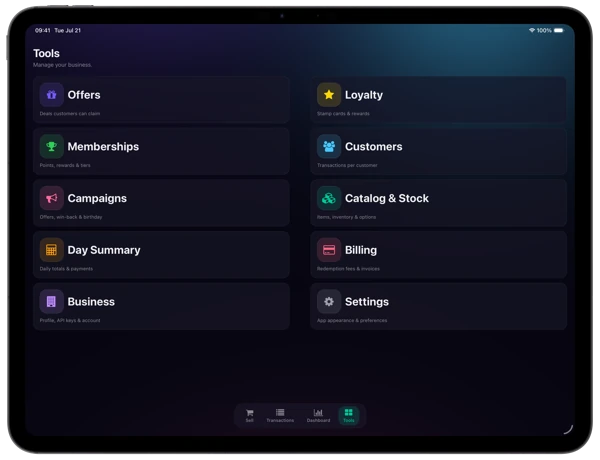
The pieces that matter for a seven-year obligation are the unglamorous ones:
- Transactions — every sale, searchable by item, amount, order number or customer, and filterable by date, amount, payment method or source.
- Day Summary — gross sales, receipt count, average, discounts given, voided count and amount, and the breakdown by payment method, for any date you pick.
- Catalog & Stock — the item list the receipt lines are drawn from, so “what was actually sold” resolves to a named product rather than a price.
- Exports — transaction data is yours, and it comes out in a file you can hand to your accountant without asking anyone's permission.
It keeps working when the connection does not: offline mode is on every plan, sales are saved on the device, and they sync with their receipts once you are back. And the customer's copy is a real record too, exportable from their own phone — which quietly solves the reprint request that otherwise lands on you at the busiest hour.
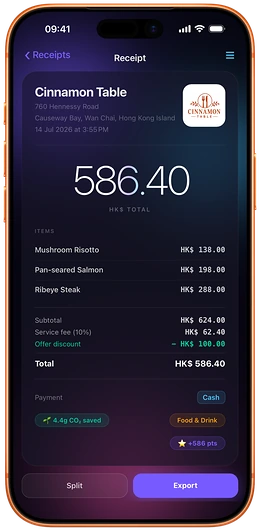
Data is stored in Asia and governed by Hong Kong's Personal Data (Privacy) Ordinance, and you see activity from your own shop and nobody else's. On the consumer side, receipts are deliberately retained rather than deleted on account closure, precisely because of the seven-year requirement — the personal identifiers are removed instead. That is set out in the privacy policy.
The practical upshot
If your sales records are thermal slips in a box, you are relying on a medium that is actively degrading to satisfy a seven-year obligation. That is a risk you are carrying quietly, and it costs money too — roughly HK$9,000 a year for a single counter once you count the rolls and the minutes.
A digital point of sale removes both problems at once, and on Loop's Starter plan it removes them for nothing. The POS system page covers what is included.
Start free, and see it at your own counter
Starter is free forever, not a trial. Tell us what you sell and what you run at the counter today, and we will get you set up.